Nyhed
Shy fish from 500 million year old genus found in large numbers in North Jutland stream
Lagt online: 30.06.2025
Nyhed
Shy fish from 500 million year old genus found in large numbers in North Jutland stream
Lagt online: 30.06.2025
Shy fish from 500 million year old genus found in large numbers in North Jutland stream
Nyhed
Lagt online: 30.06.2025
Nyhed
Lagt online: 30.06.2025
By Simon Danneskiold-Samsøe, AAU Communications og Public Affairs
Photo: Mathias Melchior
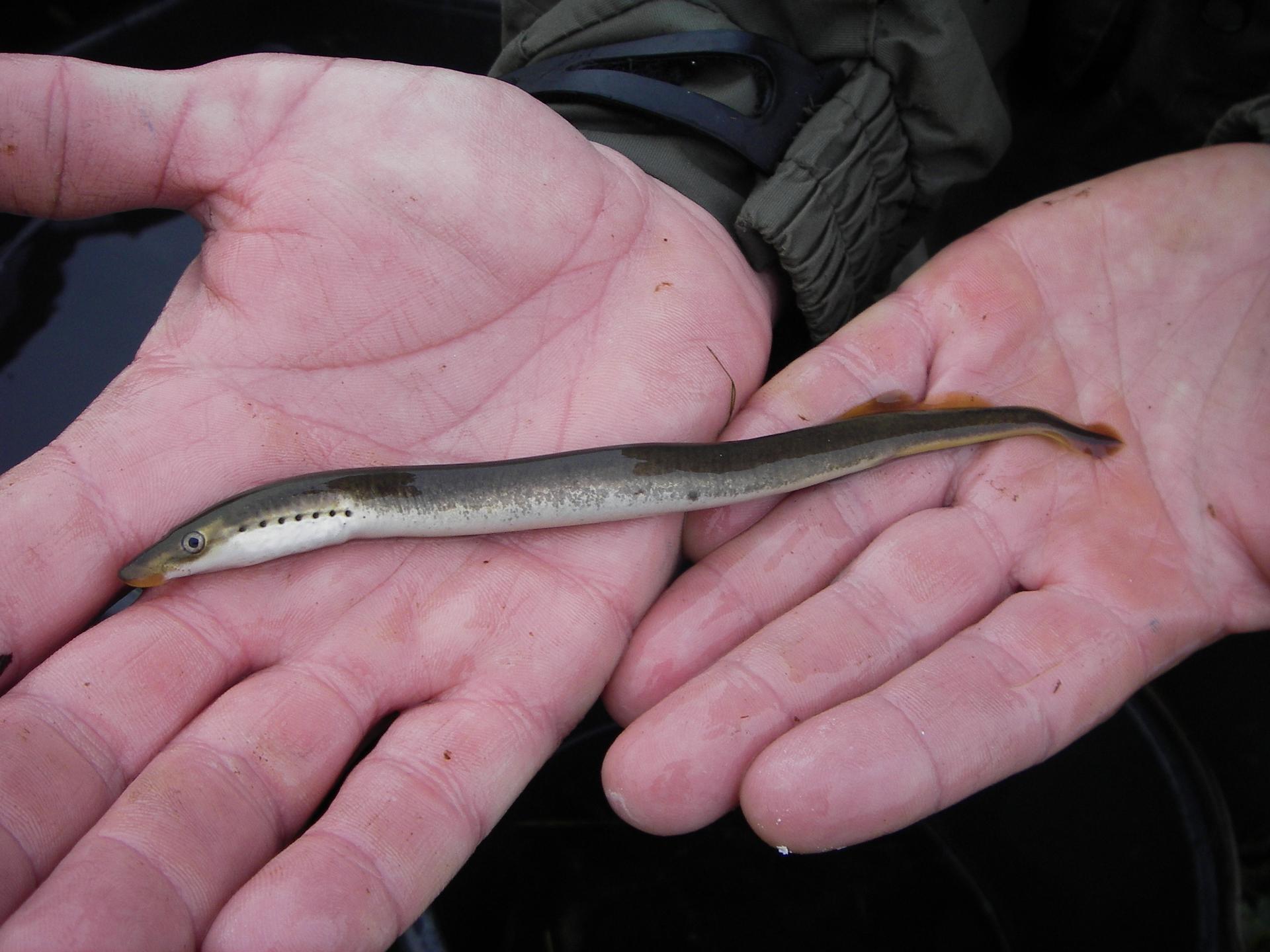
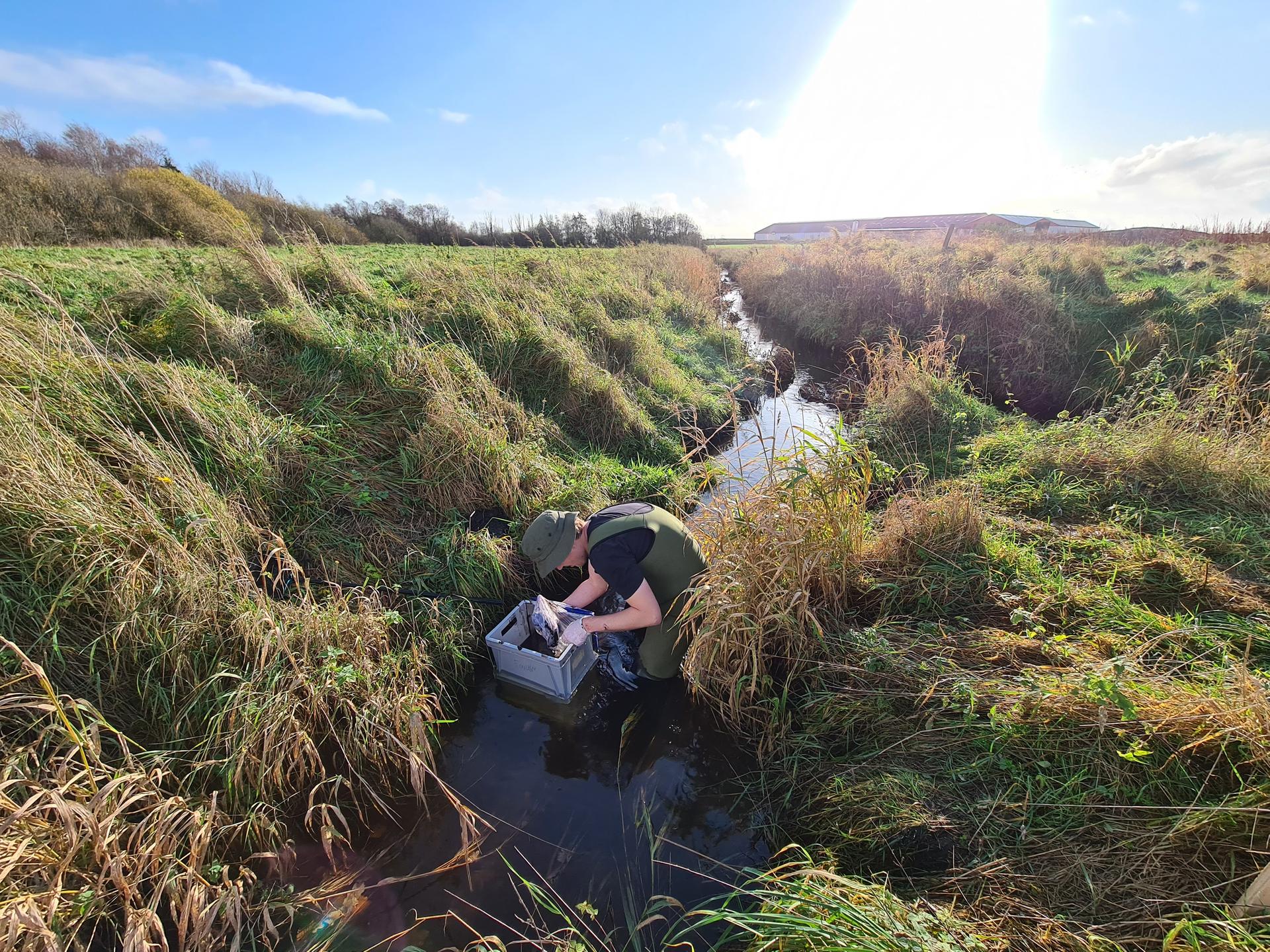
500 million years ago, there was no life on land. The ocean, however, teemed with diversity, and in the midst of the evolutionary explosion that defined the period, the Lamprey emerged. As one of the very first vertebrates, it is one of the ancestors of reptiles, dinosaurs and mammals – and thus also us humans. A study of Ovnstrup Bæk between Brønderslev and Sæby is the first Danish scientific study on the brook lamprey, and has revealed, somewhat surprisingly, that the brook lamprey thrives in North Jutland. In fact, the researchers found about four per square meter, which corresponds to about 20,000 in the entire stream.
- I’m very surprised that it exists in such large numbers. It is an important, vulnerable species, and protected by the EU Habitats Directive. It plays an important role in the stream’s ecosystem and can serve as an indicator of ecological quality. So, knowledge about its ecology is incredibly important. However, we need to keep in mind that even though 20,000 sounds like a lot, we don’t know how many there should be, if the stream were ecologically sound. In fact, there were none in the upper part of the stream, which suggests that ecological conditions are not what they should be. We need to investigate this, says Niels Madsen, Professor of Chemistry and Bioscience at Aalborg University.
A brook lamprey has an incredible life cycle; it is in a very primitive blind larval form for the first five years of its existence and lies buried in the mud at the bottom of the stream. Only its mouth sticks up to eat whatever flows in. When spring arrives after five years, it transforms (like a caterpillar metamorphoses into a butterfly) into an actual fish. Then it swims up in the water and spends a few months mating before it dies.
- From a human perspective, this might not be a particularly desirable life. But it works and has done so over half a billion years. In comparison, modern humans have existed for about 300,000 years, so the lampreys have found a recipe for survival that works. In addition, it’s also just an incredibly fascinating and relatively primitive animal that to this day is living proof of what 500 million years of evolution can do, says Niels Madsen.
The brook lamprey is listed under the EU Habitats Directive, but researchers still do not know much about their ecological role. AAU has now started research on the feeding habits of the brook lamprey with the help of DNA samples.
Niels Madsen conducted the initial study with Mathias Melchior, a former student at AAU.
Read more about the brook lamprey here.
Translated by LeeAnn Iovanni, AAU Communication and Public Affairs