Food Protein Analytics & Informatics
Food Protein Analytics & Informatics
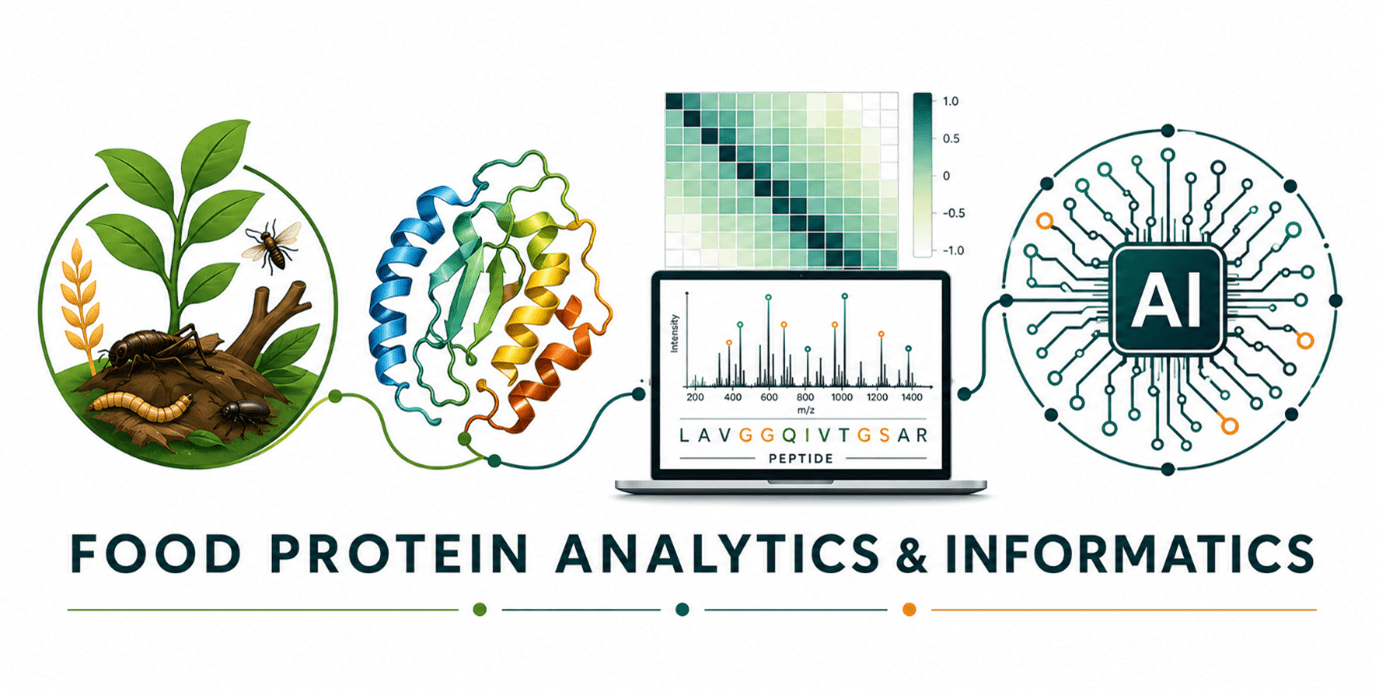
The Food Protein Analytics & Informatics (FP-AI) research group is dedicated to advance protein-based food ingredients using deep molecular characterization, protein/peptide science, and artificial intelligence to account for the complexity of biomasses. FP-AI works in the applied interdisciplinary space along three major research pillars:
- Characterization of alternative proteins and data-driven process design: We perform qualitative and quantitative protein characterization of novel protein sources for application as food ingredients. An in-depth characterization will not only improve our understanding of the protein as a potential ingredient, but we use this insight to understand and predict the effects of e.g. biomass processing, enzymatic hydrolysis, and protein extraction methods on the quantitative composition of the biomass proteome. Ultimately, this allows us to perform predictive process design based on characterization of the biomass alone.
- Quantitative methodology for challenging samples: We work towards developing peptide-level quantitative methodology for complex peptide mixtures such as non-tryptic hydrolysates and processed protein. Being able to perform accurate quantification will facilitate improved quantitative workflows and be the basis for more accurate characterization of e.g. hydrolysates
- Structure/function of peptides as food ingredients and their prediction: We focus on coupling peptide structure with food functionality and bioactivity. The ambition is to not only improve our understanding of how peptides work on the molecular level in foods but use artificial intelligence to develop advanced prediction models for peptide functionality based solely on the sequence.
Together, the three pillars will contribute to transforming alternative protein sources into high value functional ingredients. In all our work, mass spectrometry-based proteomics (LC-MS/MS) is a central methodology to create deep and quantitative datasets, that allow for further bioinformatic processing and development of AI-based predictive models. In addition to research within the three pillars, we participate in both internal and external collaborations across a multitude of research topics and scientific fields, highlighting the interdisciplinary nature of the group.