Nyhed
Indonesian mushroom transforms beer leftovers into sausages
Lagt online: 06.11.2025
Nyhed
Indonesian mushroom transforms beer leftovers into sausages
Lagt online: 06.11.2025
Indonesian mushroom transforms beer leftovers into sausages
Nyhed
Lagt online: 06.11.2025
Nyhed
Lagt online: 06.11.2025
By Simon Danneskiold-Samsøe, AAU Communication and Public Affairs
For many, a beer and a sausage go hand in hand, and now the two fan favorites are getting even closer to each other.
All thanks to a residual product, an Indonesian fungus, and the need for better use of our resources. In a research article, researchers from Aalborg University show how they successfully ferment the residual product from beer production - also called spent grain. The result is a protein-rich food that can be used in a wide range of well-known products, including as a substitute for some of the meat in the classic grilled sausages. In this way, they refine a residual product that is otherwise normally used for e.g. animal feed, into food for humans. When the spent grain is fermented, it has a higher market value and can be included instead of animal protein sources in a wide range of foods. This is good news, as there is a great global demand for protein, and traditional animal production comes with a high price for the environment and climate.
The potential of refining residues into food is therefore enormous, explains Christian Enrico Rusbjerg-Weberskov, postdoc at the Department of Chemistry and Biosciences, AAU:
- Basically, it's about making the best possible use of resources. We have a number of residual products that are interesting to try to refine, including spent grain and oat flakes. It is now used for e.g. animal feed or biofuel, but as an ingredient in food it has a higher value. Therefore, it is attractive to the producers, but the big benefit is, of course, that we can spare our climate and environment from some of the very burdensome traditional protein production, i.e., animal husbandry.
In short, the process is that the researchers add the Indonesian mushroom to the mask and with the right moisture and temperature, it ferments and creates the crucial protein. Although the process is significantly more complicated and sensitive in practice, so much grain is produced every day that the potential on a global scale is enormous. In collaboration with the Danish Technological Institute (Food Safety and Quality), different variations of sausages, pasta, lasagna and muesli bars have been produced with fermented spent grain. In the grilled sausages, the spent grain typically replaced ten percent of the meat, while experiments have also been carried out with over twenty percent. Although it does not sound like much, both nationally and internationally there are such large amounts of material that even a small proportion makes a big difference, as it can contribute to a lower meat consumption.
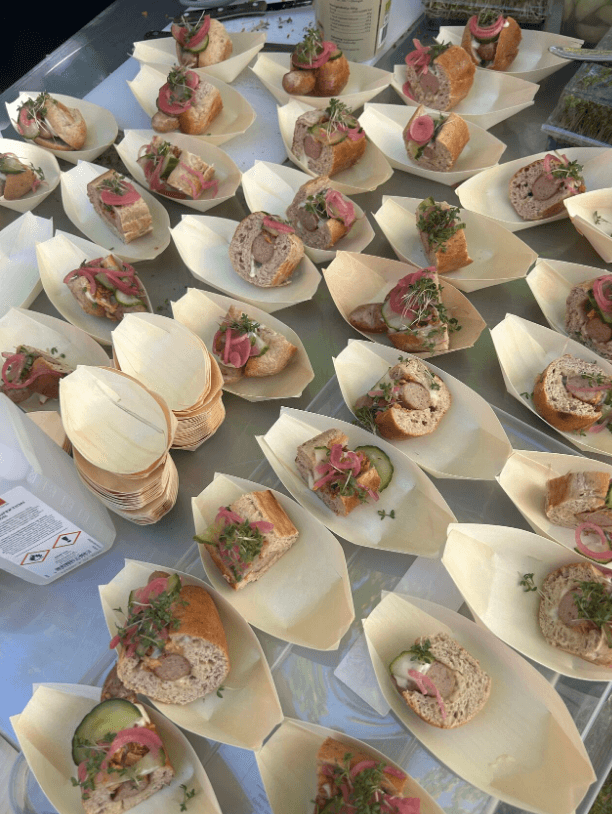
At Madens Folkemøde this year, the audience was presented with the new sausages in a blind tasting, and the assessment was that the sausages with fermented spent grain actually tasted better than ordinary sausages.
- The experience from Madens Folkemøde is exciting, because even though it is of course no proof, it gives a positive indication that there is actually a market for these sausages. Of course, it is absolutely crucial that taste and texture are to the consumers' liking; otherwise, you cannot sell them. Now we are working to show the same potential in other fermented residues, including oat husks, to establish fungal fermentation as a universal method of refining residues so that they can end up on the dining table at home," says Christian Enrico Rusbjerg-Weberskov.
spent grain is only the first step on the way, and researchers are already investigating how other residues can be converted into tasty foods. Oat husks, discarded bread and rapeseed cake – the residual product from rapeseed oil production – are some of the things that the researchers expect to turn into the food of the future with the help of fungi.
Read the full research article.
Christian Enrico Rusbjerg-Weberskov, postdoc, Department of Chemistry and Biosciences, AAU, cerw@bio.aau.dk, tel.: 5134 8873
Simon Danneskiold-Samsøe, journalist, KOMPA AAU, ssd@adm.aau.dk, tel.: 3115 7533
Daniella Høiby-Jensen, Project Manager, Food Safety and Quality, Danish Technological Institute, dhje@teknologisk.dk, tel.: 7220 2841